Creative Collision Blog

Creative Collision Blog Cross-disciplinary Creativity


Behind Creative Collision


Showing posts with label Sculpture. Show all posts

Bare

A write up about a fascinating workshop between writers and architecture students - Laboratory of Literary Architecture - lays bare the idea of space and what implications it might have when translated from writing to architectural model making. It is not a shift in medium that is utilised but the collaboration between literary folk and architectural thinkers/makers have turned up with some brilliant results.

An example:
With this narrow path I’m conveying the progression and mind of the protagonist David Lurie in “Disgrace,” a novel by J.M. Coetzee. A South African college professor who is fired after he refuses to apologize for raping a student, Mr. Lurie endures a series of traumatic events (represented by the knifelike cuts) that produce temporary changes in his perception, but he continues to believe that women have a natural responsibility to excite and bear male passion. His path zigzags, but change is illusory because ultimately he is headed in the same direction. At the end of “Disgrace,” Mr. Lurie’s new ability to relate to women as fully human is represented by a drop-off into water.
Joanne Yao, SOA Nonfiction
Partnered with Chelsea Hyduk, M. Arch ’15

See the Laboratory of Literary Architecture Facebook page for more models generated by novels.

Melbourne

A visual summary of my Melbourne trip.

Amazing street art all over the place but this is one of my favourite. Saw a few of the same artist around too - anyone know who did this? (in Stevenson Lane near Chinatown)
Federation Square
Just a mall but had so much architectural effect to the whole thing.
RMIT building by Lyons Architects

The grand hall inside the National Gallery of Victoria - stunning piece of stained glass with Victorian motifs.
Cranes were a common sight, guess Melbourne is developing around its architectural heritage.
National Library of Victoria with two exhibition spaces on the circular spaces wrapping around this central area.
RMIT Design Hub, explored the inside of it quite thoroughly.
One of the many laneways that epitomises Melbourne.

The 'Pixel Building'
An old laneway converted into the lobby of a hotel. Notice the attempt at acknowledging the heritage architecture on the right by an imperfect mirroring.
COCA - contemporary art, unfortunately closed when I went there!
An art installation in the main lobby of NGV, the bowls circulated the water pool and every time they bumped a clear ring of ceramic can be heard.

There are also more photos on my Google+ album.

Print

The device that helped a baby breathe again, custom designed and 3D printed.

3D printed bioresorbable splint helped save a baby's life

3D printing is used often in the design world to model things that you couldn't model manually (i.e. by hand) and the printers are getting more and more affordable, with some even becoming 'open source', so you can make your own using a design on the internet. The range of applications stretch to even the 3D printing of most of a gun, which is shocking and slightly disturbing.

3D printed cast for splint

Now there is a story of a bioresorbable splint being made by much finer biomedical processes that involve the scanning and modelling of a baby's breathing tube. Thanks to the University of Michigan and Glenn Green, M.D, with the cast (shown above), a skeleton can be made to help the breathing tube not collapse and then in 3 years time it will be reabsorbed into the body. There's engineering, medical design and materiality playing a big part in this innovation.

What's more, this concept may be able to be applied to other medical conditions. The custom made nature of the technology means that it is adaptable and with bodies being different from one to the other it will be great to see where this all goes.

Thanks to +Alice Pan for the heads up. It's been a few weeks since I've blogged - yesterday I had my mid-year presentation. Hopefully I'll find time to blog about it though! For other blogs on Creative Collision about science (and it does exist here as a category), visit the Science section.

Layer


Experimenting with my transparent butter paper sketches and bringing them into the 3D. Good bases for modelling off. You can see the ancestral altar sitting on one of the top tier near the ridge beam condition - I've yet to determine the nature of this ridge beam and its raising.


I've drawn different conditions: screening, rising, semi-private, alcoves. I'll have to sort out a strategy for arranging these conditions and spaces. I have some ideas of an axis moving through in spreading out vertically into these different spaces.

Ridge

Drawing ridge beam detail Chinese hall

At the moment, I'm focusing on the ridge beam and its importance in the tradition Chinese house. The book Yin Yu Tang states that the beam is more symbolic than structural. How can this be so when it is the highest building member of the frame? There is a saying in Chinese - 上梁不正下梁歪, which, in true Asian style, summarises the following in 7 thoughtful characters: if the ridge beam is crooked, then the lower members will also be crooked. This describes the Chinese house as the family within it - the association is so powerful that it is almost metaphor, just as one family member is not only themselves (as is in the individualistic Western cultures) but their whole family collective.

A real flower ball complete with a tassel.

There is also a ceremony for raising this beam. In the traditional close-knit village, everyone would be invited around for a feast and a red 'flower ball' would be attached to the ridge beam, which would sometimes be painted red. They would also perform the ritual of paying respects to the ancestors with an altar, sticks of incense, and offerings of food. A similar ceremony takes place when the site is selected too, the purpose to have the ancestors overseeing the process and imbuing the communal happiness into the house even from the early stages.

architectural model flower ball Chinese ceremony
Imposing this importance on the Balmoral site model, marking its being in the space. Also did studies of seeing it from the street above the silhouette of facades.

As I started drawing the ridge beam detail of my ancestral hall, I noticed most of it had corroded with age. Very little of the relief sculptures could be made out. So how would I find out what the symbolism was? To me, it isn't really all that important to know exactly what the symbolism is. The usual symbols can be expected of course: dragons (energy/power), phoenix (longevity, renewal), various fruits and flowers (fertility, to have sons). There's also plenty of symbolism underneath the roofline, protected by its shadow. In a way it gives me the space to create my own symbolism on this beam for my architecture - one that talks of Chinese here in Aotearoa as a shared land.

Model1

Balmoral shops heritage model architecture
Site model of a part of Balmoral, focusing on the back area behind Capitol Cinema and Warehouse building. Warehouse and rear buildings not in yet. 1 : 200 scale. 
Even with this partially completed site model, the typology of buildings next to the intersection at Balmoral can be seen. The straight edge frontage on Dominion Road, the joined shops all stretching back to various degrees. The largest building at Balmoral shops is the Capitol Cinema, the large one in the centre. Off to the extreme left, the row of shops end to the landscaped corner of the large Balmoral-Dominion Road intersection opposite Potter's Park.

Back view of Capitol Cinema Ngaire Chambers Warehouse Balmoral
Around the back, the staggered formation of buildings and for some of them, their patched together nature, can be felt. Admittedly, there are yet more little shacks attached to the ends of some of the second storey levels and in real life, cars fill up most of the indented spaces.
Street facade model of Balmoral shops
To the right hand side of the Capitol Cinema, a tiny shop was plugged in between  the heritage cinema and the Ngaire Chambers (modeled with its facade siloheutte). To the left of the cinema, there is a space like an alleyway closed off from the street with a poster ridden gate. I've left it open, perhaps a way for me to establish a connection between these interesting back spaces and the mainstreet. It also has a vertical nature.
The Unitary Plan lists Balmoral as one of the 'historic character – business’ zones. In light of future intensification, the local centre zoning also allows for up to four storeys (currently most are two storey, Capitol may be considered three) with residential units allowed on the top stories (which is what Balmoral has already). Great opportunities with the air space around these buildings but need to keep thinking about the 'historic character' of the architecture that makes Balmoral so urban and distinctive.

In terms of memory (one of the main themes of my thesis), a friend commented in studio that he knows that space between Capitol and Warehouse very well... apparently he goes there to get cardboard boxes! For others, this space is their home street, you can see by the amount of colourful laundry hanging on stair railings.

I'll be posting more about this model as it evolves - eventually I'll be adding some designed elements to it to explore what could happen in this space. I'm also looking forward to the Taniwha and Chinese Festival next Saturday (27th April) which will see a pōwhiri between Maori and Chinese. Thanks @NZBC88 for the heads up.

13

13 Rooms - the 27th Kaldor Public Art Project


13 Rooms is a collection of 'living sculpture', the 27th Kaldor Public Art Project. Is this performance art?  It has vibes of buskers on Queen St or Amanda Palmer's 8-foot bride but in the distilled gallery environment, these pieces confuse and confront. I love the ideas embedded in this variety of work.

Making a statement on the archetypal 'high art' plinth.
One of the curators, Klaus Biesenbach, talks about how you are compelled to think certain pieces are merely video installations, or a tricky projection, or perhaps a life-like model. Once you enter the room, you are faced with a live human. Art has too often taken the representation path. The realness of 13 Rooms is so much more engaging.

13 rooms Kaldor Public Art Project Sydney

It is only on for 11 days so make sure you get in quick if you're in Sydney. It's free too! Probably only on for a week because of all the staffing - they really made the effort.

Aqua


What better advertisement for a university for innovation in Peru than a billboard that demonstrates that innovation. The billboard collects humidity and has become a bit of a useful attraction for locals by providing filtered drinking water. I wish more advertisements were this useful, or at least this meaningful.

For more about UTEC's billboard, see the article by BBC.

Worm

Hubert Duprat caddis worm sculptures art

More correctly an aquatic caddis fly larvae, artist Hubert Dupprat sets up these insects to build their cocoon with materials of his choosing. The larva, in the absence of gravel, sand and twigs that is their norm, start decorating their silk cocoons with rather more precious materials: gold, semi-precious metals, pearls, gems...


Somehow the insects go about this with a sort of pattern making - some might call it "aesthetic" but for this little larvae who probably just wants to survive the ordeal, it's probably primal instinct. Strange but these sculptures are fascinatingly similar to contemporary jewellery. Minus the legs and little caddis worm head.


Something about it seems natural but the imprint of human intervention is so surely apparent. The poor creatures are also exhibited in little aquariums, showing the temporary results of a more long term experiment. From each lifecycle to another, a new insect may choose a previously made case and expand/rework it.

For more about The Wonderful Caddis Worm: Sculptural Work in Collaboration with Trichoptera see Leonardo Online or read an interview with the artist himself. 

Silo

Silo Park by night

Askew One silo park street art sculpture

I actually can't believe I haven't blogged about this before because I'm a real ranting fanboy of Silo Park and Wynyard Quarter. Right now 'Summer of Sculpture' is on, turning the urban waterfront park into an interesting sculpture walk. In the period before this, Askew One, a renown NZ street artist that I've featured before, did a series of pieces on the decommissioned silo tanks (see above). They act as a backdrop to all of the activity and signals the increasing move towards making Silo Park as a space a creative one. The sculpture in the foreground is one of the many great pieces out there at the moment (the pose kind of reminds me of Assassins Creed).

Viaduct Events Centre by Moller Architects

In fact, the park holds many creative disciplines - music (there's even an old piano sits in one of the silos, for anyone to play on), films with the summer outdoor movie nights, dance, art, fine cuisine in the night market stalls/restaurants architecture and award winning urban design. 


Imagine that just a few years ago, this space was a broken down industrial waterfront. I hope that the spirit in the place is what Auckland as a whole can move toward - an accepting space open to rejuvenation and creativity.

Deadly

Luke Jerram glass sculptures microorganisms germs

Today in the office I heard someone say "I wouldn't wish meningococcal on anyone!" (nor would I..) There's a real fear about the deadliest of diseases, the intangible danger and risk of catching one of these nasties belies the true from of these strange organisms.

Artist Luke Jerram takes these microscopic forms and, magnified countless times, creates glass sculptures. Whether or not a feat of biology or evolution, the established shape is mesmerisingly beautiful but at the same moment, terrifying. Terrifying that these shapes, honed to perfection for efficiency of invasion, can enter a blood stream and cause a horrific struggle with one's own body.


Aesthetically, are we drawn to these nature built forms? The prettiest of flowers vs these intricate forms. But once you know what it is - flashbacks from your biology textbook perhaps - these amazing creatures can really freak you out especially as a glass sculpture. Especially the virus one, more by common association more than anything.

I've come to notice there are an increasing number of posts that involve science on Creative Collision so now there is a new Science tag for those who might be interested in the marrying of science and creativity! As a great fan of science, they have some really amazing work out there and just because they aren't usually considered a creative discipline doesn't mean they don't work together.

Pollution

What is pollution? A powerful word with an equally devastating consequence, it lingers on the mind of many. But pollution can also enter our very beings - a timely reminder being this piece by Nolan Gapske titled "Pollution of the Mind".

Nolan Gapske Pollution of the Mind photo

My first thoughts were somewhere along the lines of Damien Hirst - the skulls and swirls and so forth. But this photo captures a much more temporal nature that embodies its subject. Hirst's skulls are objects: hardened resin, colour, studs, diamonds (or was it crystals? something insanely extravagant). They rely on that solidarity as a part of the statement.

It is fitting that photography is the medium for this, fleeting moments of this intrusion and beauty. Reminds me of the high speed photographs of sound sculptures but much more lethargic in nature.

Pollution is something we want to reject, but too easily does it mingle and become inseparable. Talking about the pollution of the mind, can we really reject the unwanted which is so interwoven with our very fabric?

You can check out more of Nolan's work on his Flickr page or his menswear blog Azzimoto.

Turn

Now that all of that fashion business is over, let's move onto something more architectural and reorientate ourselves... or not.

Turning the Place Over by Richard Wilson

Mist


Cai Guo Qiang's Endless presents a poetic collision of culture. However, without the bang and boom of other cultural advents such as the symbolic collision of 911, this installation shows two types of traditional boats (Chinese and Middle Eastern) lost in a mist. The encounter is sombre and the inherent stillness of the mist infects the piece.


The ephemeral and anti-stability theme is explored by many Chinese artists. Just today, at the Auckland Art Gallery I saw a series of photographs by Song Dong which spoke a similar language. A Pot of Boiling Water contained elements of performance art, as Dong pours boiling water from a kettle onto an old street of Beijing - the steam is temporal and the words written fade to the stability of stone.

Cai Guo Qiang Endless

Offerings

Ornamental Thoughtfulness Wellington Art

A wonderful little concept is being played out in Wellington at the moment. Ornamental Thoughtfulness is a subtle gesture in the urban environment, where little bronze hands are being attached where people can place offerings to others. It's street art that encourages others to be creative.

Offering a piece of chalk to draw with.

Discover/write a secret note.

It reminds me of a similar concept I posted about in 2010, Dead Drops, which allows anonymous sharing via USB flash drives hidden around the city (I wonder if they're still there?). With all of these projects there is always some risk involved - vandalism, inappropriate 'offerings', a virus or two, but especially with creative street art projects, it is the risk factor that gives it some oomph. Street art isn't supposed to shy away; it should confront people who discover it in their environment.

Interested in street art? Browse the Street section of Creative Collision.

Thread


Yuriko Sakai's 'The Room of Kappa' rivals that of Chiharu Shiota's work in the way she uses thread in space. Unlike Shiota's relational lines of chaos, Sakai created a space of absolute orderliness. From the horizontal planes that frame the work to regularity of the angles and intersections, there is something zen about being in the presence of, or being in such a sculpture.


Thanks to Spoon and Tamago for the heads up.

Gibbs

Today I finally made it to Gibbs Farm with the team at Architecture for Humanity Auckland. As a NZ art aficionado, it was truly a highlight. Gibbs Farm is a sculpture park of sorts featuring an extraordinary assortment of sculptures commissioned by an obviously very wealthy Mr Gibbs. It brings art from famous sculpture artists from around the world and sets them in a very New Zealand context. The rolling green hills, the pure blue sky and the harsh NZ light brings together this fantastic collection.


Of course, as with all good farms, there are animals abound although these ones were more exotic specimens. Giraffes could be fed near the entrance, alpacas, turkeys, zebras, stags and more could be seen as you wander the site. Having an emu walk beside us at the Richard Serra was all a part of the experience...

Maya Lin

Unknowingly embarking on the walk (read 'hill hiking') around the sculptures, one of my party told me there was a Maya Lin, in which I had a mini moment of excitement. And there it was (visible from the TOP of the hill). Renown for her landscape art, this is still under construction although it looks like they've lumped together enough dirt to farm a small town. The subtle interplay of proportions are the set for whatever this piece will turn into.

Bernar Venet 88.5 Arc x 8

Most extravagantly sitting on the site, and most visible, was Bernar Venet's 88.5° Arc x 8. It was one of my favourites in the collection. It didn't sit on the site as much as it poised, dancing on the hilltop. Seriously, you can't see how the thing is supported. It is a fairly new piece. Corten steel is all the rage these days with architectural works by RTA Studio (eg Ironbank on K Road) being held up high. I actually saw some sculptures from Venet's 'arc' series at Wynyard Quarter (unless I'm very mistaken), and it was nowhere near as powerful as this. 

Anish Kapoor Dismemberment

The most famous sculpture of the farm is Anish Kapoor's Dismemberment, Site 1. I'm a fan of Kapoor's work, the more intimate ones I've seen are, in my opinion, more effective. You felt like you were standing at lip of a giant ear drum and there was something disturbingly anatomical about it. A theme that ran through Gibbs Farm was the striking blue, red, green colour blocks created by a clear sky, red sculptures and the green hillocks.

Len Lye Wind Wand

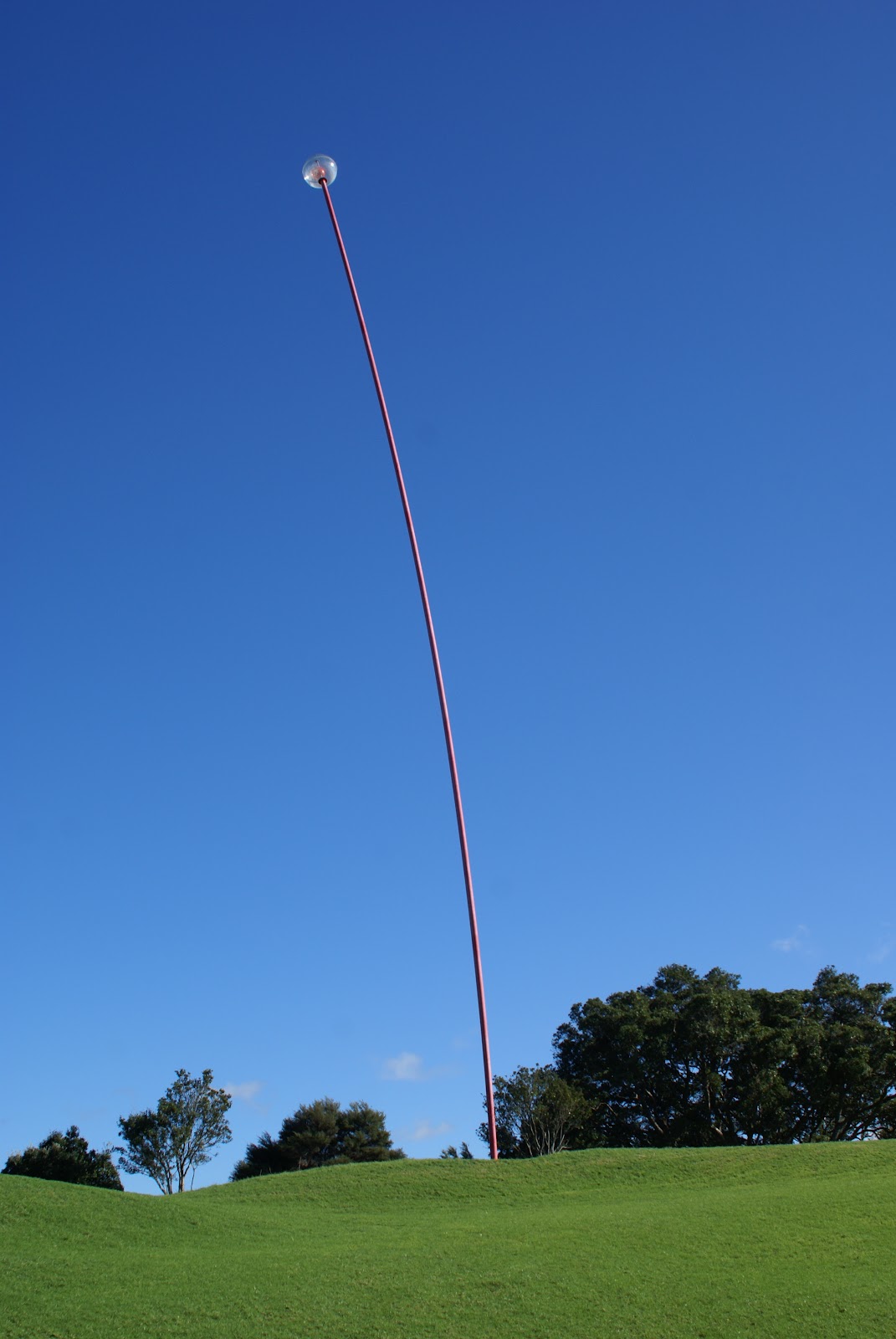
Good old Len Lye created this Wind Wand and apparently the thing at the top is created by Eric Orr and emits forked electric sparks. Of course, on this fine day you see none of that and even the wind didn't allow us to see the carbon fibre in action. Not that we were complaining.

Neil Dawson Horizons

Have got to say, I am a huge fan of Neil Dawson. There's even one at the University of Auckland campus (Chevron) so I get to walk around it all the time. His work impresses me at every angle (excuse the pun). This piece is named Horizons and is a tangent from his other work. A master of 2D-3D manipulation, Dawson created this enigma that playfully imprints itself on our New Zealand sky like a Lichtenstein print. As we approached it we wondered: is it 2D or 3D? This coming from a bunch of architecture people, we were all tricked by the illusion. You'll have to visit the farm to get the trick! This was one of my favourites.

Zhan Wang Floating Island of Immortals

A strange one was this chrome-like blob that shone from a distance. It actually floated around as we were figuring out what it was. Consulting the guide book, it was created by Chinese artist Zhan Wang, Floating Island of Immortals kind of summarises it quite well. Note how Gibbs really likes his ponds.

Richard Serra Te Tuhirangi Contour

The king of giant sculture art, Richard Serra graced this farm with his great wall Te Tuhirangi Contour which was really stunning, even when seen from the entrance, eclipsed by the hills. I remember the first time I was taken back by Serra's work reading about Monumenta 2008. Mass and scale aside, the acoustics at certain points in the curve enriched the walk with some powerful echos.


I don't think I've had this much of an art orgy since visiting the Tate Modern in London. Needless to say, people, you have to go and visit this gem in the Kaipara Harbour. Just goes to show there are some really great things sitting in our backyard (or at least Auckland's backyard..) so turn off the rugby and see some phenomenal art! You can just imagine Alan Gibbs sitting in his enormous property soaking it all in but what a generous thing to share his contribution to the NZ art scene to the rest of us.

Visiting instructions are available on the Gibbs Farm website. Entry is free although donations to the Kaipara Harbour area are welcome at the door. There are open days once a month.