Creative Collision Blog

Creative Collision Blog Cross-disciplinary Creativity


Behind Creative Collision


Showing posts with label Travel. Show all posts

Bed

Here's a blog post talking about how I did a small project of my own - building a car bed in my Nissan Tiida hatchback for small road trips.

Pro-tip: always reverse into the best view.
Ever since going camping in my friend's Honda Fit - a relatively small hatchback - I started thinking of what I could do with my own car. My workmate also removed the back seats from his van and created a plywood haven with a kitchenette, providing inspiration. Staying in Airbnbs and motels/backpackers can get a bit samey and I've always wanted to give the character-filled camp sites a go without the drama of a tent.

The Honda Fit has the advantage of having the back seats lay down flush with the boot floor, so add a foam mattress and you're sorted. My Nissan Tiida is a different story - the seats laid down are quite a bit higher than the boot so it needs something to raise it up.

The Tiida is longer than it looks and with the front seats pushed as far forward as possible, there is just enough length for me lying down. Anyone shorter should be fine!

The car bed in it's set up state, mattress in. You can see the storage space underneath.
Chuck bags up the front, less used items underneath, the arm rests/door pulls hold our phones. 
Putting my architect skills to good use, I measured it up and started drawing.

Lying down in the car, I could get a sense of how much room I would have to sleep. Headspace is an issue, but it is passable. The simple X-shaped baffle support was the brain child of my fellow architect Han. Highlights the importance of bouncing ideas off others. One of my engineer friends thought up something far too complicated. Go architects!
I ended up purchasing a single sheet of 1.2 x 2.4m plywood (12mm thick) and cutting them into panels. Then a few cut outs and some sanding later, it was all done!

A bit of planning before prefabrication, always best to use material as efficiently as possible. I also made sure the plywood was E0 grade which means that almost has no toxic formaldehyde emissions as we would be cooped up in the car with it.
All it needs is a bit of set up and a thin self-inflating mattress. Unfortunately the head space isn't very much but it's alright as a sleeping platform. Feels like a capsule hotel in Japan. The upside of building it up a platform is that we get storage space inside the baffle construction.

A few details: we made 'curtains' with suction cups to stick to the inside of the windows. For the back seat windows we opened them up a crack for cross ventilation and put mosquito nets over the doors.


None of it is permanent, it's just a few plywood panels that can be removed through the side door. To drive, we just slide the panels on top of each other and slide the front seats back to driving position.

Now we can do weekend road trips easy as!

Backyard

Oakley Creek (Te Auaunga) is one of Auckland’s longest urban streams
It's not often I haven't heard of a place in my own backyard, and the Oakley Creek Waterfall is certainly one of them being only 12 minutes drive from home. I went to investigate and was not disappointed.

It is the only natural waterfall in Central Auckland, and hidden away. It's small and peaceful, but being fairly secluded, it is recommended you go there with a walking buddy. Bring a picnic, it seems to be the way to do it.

There are multiple ways to go onto the walkway and it's all worth a bit of exploring - the signs aren't too helpful. And the typical Auckland question: where do you park?! Google Maps show the track and it depends on where you start from. There are plenty of side streets off Great North Road, some which feed directly into the walkway behind people's houses. You almost feel like you're in their backyard sometimes, for lack of a fence.

A map of it's features, visit the Friends of Oakley Creek website for the full version.
Oakley Creek is like the water spine of the isthmus, going from north Hillsborough near the Manukau Harbour, through Mt Roskill, Waterview (where all the motorway works are occurring) and out to the Waitemata Harbour. Locals may have experienced parts of it, such as the stream running past Mt Roskill Grammar, or the riparian areas in Unitec. Over the years a nice walking track and viewing platform has been constructed to allow better appreciation of this natural habitat, running roughly parallel to Great North Road from the motorway onramp.

Swimming is possible by reports of people jumping in, but I couldn't find any official advice to this. Common sense tells me the stream runs through the length of urban Auckland, so it would accumulate things along the way. Perhaps not swimming there a few days after the rain is advisable which is what we would do at the beaches fringing the city.

The Friends of Oakley Creek (est. 2004) have taken upon themselves to "protect, enhance and restore the ecological health" of the Oakley Creek Environs. They have a map of the walkway, as well as educational events that promote its environment needs. A nice half-day adventure if you're up for it!

Melbourne

A visual summary of my Melbourne trip.

Amazing street art all over the place but this is one of my favourite. Saw a few of the same artist around too - anyone know who did this? (in Stevenson Lane near Chinatown)
Federation Square
Just a mall but had so much architectural effect to the whole thing.
RMIT building by Lyons Architects

The grand hall inside the National Gallery of Victoria - stunning piece of stained glass with Victorian motifs.
Cranes were a common sight, guess Melbourne is developing around its architectural heritage.
National Library of Victoria with two exhibition spaces on the circular spaces wrapping around this central area.
RMIT Design Hub, explored the inside of it quite thoroughly.
One of the many laneways that epitomises Melbourne.

The 'Pixel Building'
An old laneway converted into the lobby of a hotel. Notice the attempt at acknowledging the heritage architecture on the right by an imperfect mirroring.
COCA - contemporary art, unfortunately closed when I went there!
An art installation in the main lobby of NGV, the bowls circulated the water pool and every time they bumped a clear ring of ceramic can be heard.

There are also more photos on my Google+ album.

Brake

Brake House by Ron Sang

Yesterday I had the rare chance to tour the famous Brake House in Titirangi thanks to the Auckland Architecture Association. Designed by architect Ron Sang, a prominent Chinese New Zealander, the house was completed in 1976, before leaky building syndromes and building regulation reforms. The elegance of the house in Titirangi's signature wild naturesque landscape reminded many of American designs like Frank Lloyd Wright's Fallingwater House.


Immediately upon entering the house, you felt the sense of attention to detail that encompassed the architecture of that period. The platform leading into the house had a precarious edginess to it. Eventually we figured it out - a lack of our standardised contemporary handrails. Any such feature (your usual 1m high, grabbable railing) would have destroyed the elegance of the design entirely.


Originally designed for Brian Brake, one of New Zealand's most famous photographers, the house includes a studio, dark room, cinema downstairs as well as plenty of glazing and platforms. As a Japanophile, Brake requested a tatami room (this is the glass box floating out into the bushes, shown above).

Incredible reflections all throughout the house, merging nature and architecture.


Brake House by Ron Sang


The architect Ron Sang came and gave us an intimate insight to the making of this house.
Visiting this house is such an inspiration, but as Ron Sang said, there is no way such a house can be built as it is now because of the many regulatory constraints. Back in the 70s, this building only needed 20 A1 sheets to document it - these days you would need at least 100 sheets marking the incredible change that the architectural profession has had over the years. The fusion of Asian and American design in the woodiness of Titirangi is an incredible feat though and, for those who afford it, it is currently up for sale.

Sign


In a block of medium rise buildings in the CBD on Anzac Avenue, I found yet another little food court snugly inside a long narrow shop space and jammed full of various cuisines and different shops. The signage marks this out on the street - they attempt to draw you in.


In Melbourne, the Chinatown was where street signage was the most prominent. A cherry picker was there putting up a new sign. It's as if the heritage building that they were applying it to would change function with it. Such a programme is interchangable as different uses and people are injected into architecture. Same for the Imperial Building (which is talked about in this post about urban connectivity) - the ROXY sign on Fort Lane signals the bar on the rooftop (which apparently might be closed now?), the name Roxy coming from the theatre that used to be in that old building. Architecture is constantly repurposed - churches turn into bathhouses, theatres into rock climbing walls (which is what happened to the Capitol Theatre).


Signage plays a big part in pronouncing new function but also creating a connection with the street. And as we know from the Asian street, it adds to a vibrant bustling atmosphere.

Transform


Last week I flew over to Melbourne to attend architecture conferences run by our Australian counterparts. I attended Transform, a fringe event to the national architecture conference Material. Underscored by 'Altering the Future of Architecture', it was a fitting title that reflected the day's programme.

Transform architecture conference Melbourne equity
One of the many panel discussions.
Initially the conference was pitched to me as an event about gender equality. The primary instigator was Parlour (women, equity, architecture), so naturally the increasingly discussed topic of women in the workplace was at the forefront of the participant's minds. On top of this important equality discussion, the event was about the profession in general and the themes discussed were applicable to all, not just women.

The crux of the workshops and talks was,

"If architecture was more inclusive would it also be in a stronger position?"

It was a lot to think about within the space of a day, especially with the perpetual dialogue between various practitioners, academics, students and foreigners. Listening to various positions on the subject, engaging in workshop discussions and taking part in frenzied networking (also known as tea breaks) certainly gave a full bodied experience around the issue of transforming the status quo of the profession. Undoubtedly, everyone left the day with a more open mind about what 'architecture' as a profession is in the 21st century.

A formidable project taken on by the team at Parlour was to create a set of guidelines for work equity, a list of pressing issues for the workplace: pay equity, leadership, recruitment, mentorship, negotiation, long hours, part-time work, flexibility, career break and registration. The 'equity guidelines' that are at a draft stage at the moment (and are open to feedback so do leave a comment for the Parlour team) are specifically tailored to women in architecture, but are weighty food for thought for anyone in the industry - male or female, student, graduate or established practitioner, alike.

Round table discussion.
Any industry undergoes constant change but during the last decade the architectural profession appears to be breaking the mould a bit. The diversity of the career path in architecture was elaborated on via panelists talking about their approach, whether it be by branching out to other disciplines, different funding models or reinventing architecture as we know it. It was so good to have the discussion at such a scale for Australia/New Zealand.


This discussion will come to NZ in the form of Architecture Week 2013 - Architecture + Women NZ (A+W NZ) is holding a similar event – A+W NZ's core team was there at the conference, seeing how a similar event could be run here. There will be keynote speakers along with an exhibition and possibly a designed pavilion erected for the week. The visibility of the architectural profession, equity issues and the role of women in architecture will be the focus of the event. I'll let you know more as it develops.

Dream

A short film of Ian Ruhter's photographic process reveals a practice of inspiration. Often a camera is used as a mere tool for capturing images, but Ruhter's 'camera', which is held in a baby blue truck, exposes the lives of others (pun intended), or more accurately, their way of life.


Whether intentionally or otherwise, Ruhter's practice brutally disassembles the 'American dream' - that it is not for everyone, nor is it essential for a happy existence. Finding your own happiness is in your own hands and no one else's. The truck travels around documenting the American existence. Certainly he can't document ALL of it (most of it would be pretty banal anyway) but he sure has a knack of finding the more interesting characters around.

Ian Ruhter LA skyline camera fence
"The LA skyline photo is so important to me. That fence symbolises every fear, every doubt. Once we went over that fence, our trip to America began." 

Using a full plate film technique, crisp details can be blown up. He can inhabit the camera - in the film you can see the world in reverse around him like being in a giant pinhole camera (some spaces are made for this purpose). Doing both portraiture and landscape/cityscape photos, it links the peculiarities of the city with those inhabiting it with their particular stories. The technique reminds me of the chemigram, the imperfections mirror the imperfections of humans.

Blogger's note: I need to stop talking about photography for a while... this blog is becoming a photo blog or something!

Nostalgia

China Pavilion people dwarfed nostalgia big Shanghai Expo

The Round Robin Photo Challenges is a blog I bumped into randomly the other day. At a predetermined challenge date, people post up a photo according to a theme and link back to it in the comments, allowing others to appreciate a collection of work that is almost curated around the theme.

This time the theme is "Long Ago, Far Away" and definitely a good excuse to trawl through old photos that would otherwise just rot away (OK, not really) on the hard drive. This photo is from the Shanghai World Exposition of 2010, the China Pavilion which was, of course, the grandest, largest and most boastful. A great moment on its doorstep was seeing how the building literally dwarfed the people lining the bottom of the photo. Perhaps it's not all that long ago that this was taken, but it sure feels like a long time and so far away from life here in NZ.

Crumble


The illusion of the timelapse hides the fact that these demolition processes take an awfully long time as they have to break through all of the architectural technologies that we rely on to be very strong.


In 2011, I remember standing in the Christchurch CBD and watching one of these huge jaw-like machines crunch away at concrete and reinforcing steel. The machine itself was sitting on a hill of rubble of its own creation and a powerful cannon of water was used to drench the dust that would otherwise smother the adjacent surroundings. Hardly as dramatic as a blow up demolition, this building was the MLC Building (cnr Hereford and Manchester St), one of the first highrises in Christchurch at 11 storeys. Before the large Boxing Day aftershock it was planned to be saved. Talking to some of the locals standing around watching the building go down, there is a nostalgia to think that this huge building will become void, then as the memory fades, something else will replace it.


The MLC Building's staircase to nowhere.

China1

Found in my draft posts, this was one of many posts about my China travels that I was wanting to post. However the email posting didn't quite work as planned and ended up as a draft! A bit belated, and there will be more China pics to come later on.


As some of you might know, at the moment I'm travelling China in search of my family's roots. Today I visited various sights around Zengcheng in Guangdong, China. The best sight was the famous waterfall called Baishuizhai, climbing all the way to roughly the top, it was a easy hike with some stunning, if a bit fabricated, moments. Most strikingly, we were told that the waterfall only runs so strongly during periods of no rain because of two reservoirs of water at the top, released when naturally its flow wouldn't be so dramatic.


Another beautiful sight was an old dam called Dafengmen, with picturesque mountains and a milky green body of water. The structure itself was stunning with really crafted details. The mass of it all really worked with nature - it reminded me of the formalistic Spanish contemporary architecture (think Raphael Moneo).

Eventually I'll get around to editing and picking out some good photos, possibly when I'm back in NZ. Unfortunately I can't even access Blogger here on the other side of the Great Firewall and will have to make by via email posting. I don't even know if it works, so... somebody let me know!

Mentawai

Time to end this blogging drought! Having been to China, it was a great cultural overload even for me. And without a way to access Blogger, Facebook or Twitter due to the Great Firewall, I've felt pretty oppressed. I am still taking my time processing the many photos I took of my China trip + ancestral village, so those will come in due course.

On a side step, I saw this fascinating video of Joey Lawrence trekking through the Mentawai with waaaay too much equipment to photograph the remnants of this rare and rich way of life (ignore how this is a huge advertisement - I swear I could have done just as well with my cranky old Sony DSLR).


"Hello people from the entire world! Come to the islands of Mentawai quickly. Right now, the Mentawai are still alive. I am still alive. But when I die, you will not see my culture any more."
Cultures like the Mentawai are dying out. A series of photographs show the old grandfather (I presume) with their grandchild, the elder in the traditional garb and the younger donning common western clothes. There must be a handful of cultures that still keep so true to how they have existed for centuries. It is this same handful of cultures that slips out of one's grasp like sand from the palm of one's hand.

One can only hope that the hauntingly moving chants and traditions are carried onto those with the Donald Duck T-shirt and muscle tees. Maybe.

Throughout China I've seen an enormous disregard for historic artefacts - there's just so much of it and the pressures of the current age quite easily stamp them out. Often is the sight where an old stone abode crumbles to the weather to be replaced by a really ugly new and much taller building. But that is for another blog.

Us

After a gruelling semester of architecture studies, I'm back on the blog (and Twitter) after my usual crit hiatus. Something that's been lingering on my bookmarks bar for a while is the Us cover of Rihanna's hit 'Where have you been'.


Very rarely do you find a cover as innovative as this. The husband wife duo, Carissa Rae and Michael Alvarado, created a fusion of genres for this very familiar pop song, with hints of classical influence, rock, jazz and a unique interpretation. Do enjoy and I'm looking forward to blogging over the summer, especially with an upcoming trip to China's villages!

Check out more from Us on their website HaveYouHeardOfUs.com. If you like their work, make sure you support them by purchasing their song or album.

Ambury

Ambury Regional Park, from the coastline.

Having gone to Ambury farm to do some investigation on the Manukau Harbour, I was stunned to discover the rich palatte of colours on this hidden coastline. It is a part of the foreshore walk, I think, but from Ambury Farm, it is cut off by two large paddocks. Bright yellow lichens were on the rocks, lime jelly green seaweed in the cracks. Deep grey on the volcanic stone. Worth exploring.

Gibbs

Today I finally made it to Gibbs Farm with the team at Architecture for Humanity Auckland. As a NZ art aficionado, it was truly a highlight. Gibbs Farm is a sculpture park of sorts featuring an extraordinary assortment of sculptures commissioned by an obviously very wealthy Mr Gibbs. It brings art from famous sculpture artists from around the world and sets them in a very New Zealand context. The rolling green hills, the pure blue sky and the harsh NZ light brings together this fantastic collection.


Of course, as with all good farms, there are animals abound although these ones were more exotic specimens. Giraffes could be fed near the entrance, alpacas, turkeys, zebras, stags and more could be seen as you wander the site. Having an emu walk beside us at the Richard Serra was all a part of the experience...

Maya Lin

Unknowingly embarking on the walk (read 'hill hiking') around the sculptures, one of my party told me there was a Maya Lin, in which I had a mini moment of excitement. And there it was (visible from the TOP of the hill). Renown for her landscape art, this is still under construction although it looks like they've lumped together enough dirt to farm a small town. The subtle interplay of proportions are the set for whatever this piece will turn into.

Bernar Venet 88.5 Arc x 8

Most extravagantly sitting on the site, and most visible, was Bernar Venet's 88.5° Arc x 8. It was one of my favourites in the collection. It didn't sit on the site as much as it poised, dancing on the hilltop. Seriously, you can't see how the thing is supported. It is a fairly new piece. Corten steel is all the rage these days with architectural works by RTA Studio (eg Ironbank on K Road) being held up high. I actually saw some sculptures from Venet's 'arc' series at Wynyard Quarter (unless I'm very mistaken), and it was nowhere near as powerful as this. 

Anish Kapoor Dismemberment

The most famous sculpture of the farm is Anish Kapoor's Dismemberment, Site 1. I'm a fan of Kapoor's work, the more intimate ones I've seen are, in my opinion, more effective. You felt like you were standing at lip of a giant ear drum and there was something disturbingly anatomical about it. A theme that ran through Gibbs Farm was the striking blue, red, green colour blocks created by a clear sky, red sculptures and the green hillocks.

Len Lye Wind Wand

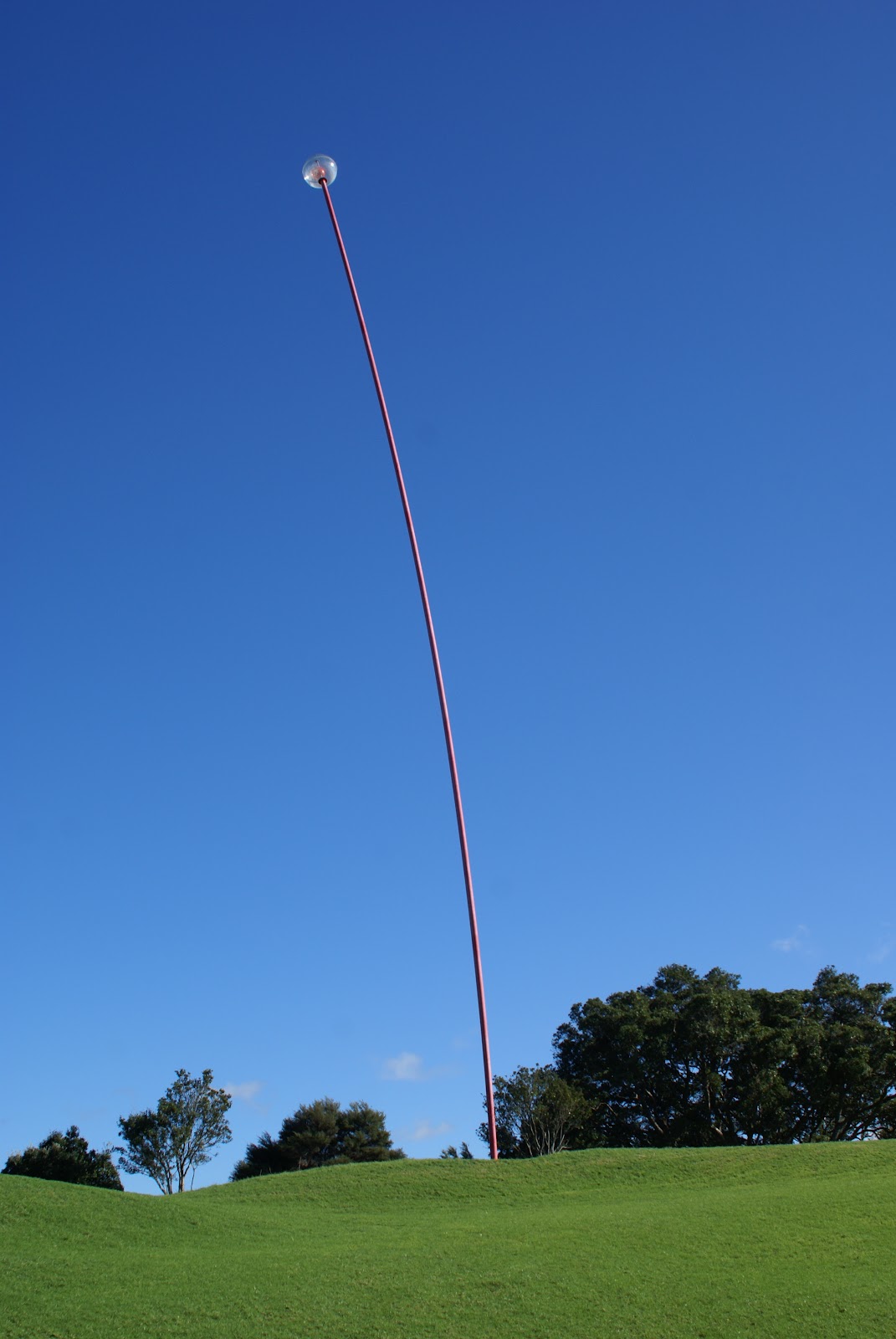
Good old Len Lye created this Wind Wand and apparently the thing at the top is created by Eric Orr and emits forked electric sparks. Of course, on this fine day you see none of that and even the wind didn't allow us to see the carbon fibre in action. Not that we were complaining.

Neil Dawson Horizons

Have got to say, I am a huge fan of Neil Dawson. There's even one at the University of Auckland campus (Chevron) so I get to walk around it all the time. His work impresses me at every angle (excuse the pun). This piece is named Horizons and is a tangent from his other work. A master of 2D-3D manipulation, Dawson created this enigma that playfully imprints itself on our New Zealand sky like a Lichtenstein print. As we approached it we wondered: is it 2D or 3D? This coming from a bunch of architecture people, we were all tricked by the illusion. You'll have to visit the farm to get the trick! This was one of my favourites.

Zhan Wang Floating Island of Immortals

A strange one was this chrome-like blob that shone from a distance. It actually floated around as we were figuring out what it was. Consulting the guide book, it was created by Chinese artist Zhan Wang, Floating Island of Immortals kind of summarises it quite well. Note how Gibbs really likes his ponds.

Richard Serra Te Tuhirangi Contour

The king of giant sculture art, Richard Serra graced this farm with his great wall Te Tuhirangi Contour which was really stunning, even when seen from the entrance, eclipsed by the hills. I remember the first time I was taken back by Serra's work reading about Monumenta 2008. Mass and scale aside, the acoustics at certain points in the curve enriched the walk with some powerful echos.


I don't think I've had this much of an art orgy since visiting the Tate Modern in London. Needless to say, people, you have to go and visit this gem in the Kaipara Harbour. Just goes to show there are some really great things sitting in our backyard (or at least Auckland's backyard..) so turn off the rugby and see some phenomenal art! You can just imagine Alan Gibbs sitting in his enormous property soaking it all in but what a generous thing to share his contribution to the NZ art scene to the rest of us.

Visiting instructions are available on the Gibbs Farm website. Entry is free although donations to the Kaipara Harbour area are welcome at the door. There are open days once a month.