Creative Collision Blog

Creative Collision Blog Cross-disciplinary Creativity


Behind Creative Collision


Showing posts with label Culinary. Show all posts

Tastes

I found an extraordinary map today. At first it just looks like the London tube map (which is in it's own right famous - even the Congestion Free Network adapted its structure to express their plan)

What this map created by James Wannerton, who has "lexical-gustatory synaesthesia, a condition characterised by the involuntary taste testing of words; it is the conflation of senses that are normally experienced separately." So over 38 years, he has recorded the 'taste' of every place connected to the public transport network of London.


The exercise highlights the value of experiencing a place - when a place becomes so familiar that it has a special place in your psyche (or taste in this case), then there's something cognitive going on. Places are what we make of them, individually as much as collectively, their ambiance adding to the flavour of it.

For more see the Co.Design article. Also remember that the Architecture + Women NZ exhibition is on next week for Architecture Week, make sure you check it out.

Diversity


Providing for a range of people and their activities is a fundamental part of designing for diversity on an architectural scale. This also happens on an urban scale (around the city) - space is known to inspire diverse users as much as a diverse population for an area creates different spaces.


Using a layered drawing approach, I work between scales, exploring the concept of 'diversity space'. At 1:20 (drawings above), the detail of how one looks at produce in the market spaces, or drinks their coffee in front of their laptop becomes apparent. At 1:100 (pictured below), I can see how people will inhabit the spaces en masse and test whether or not there are a variety of spaces for people to choose to use. This is similar to a blank restaurant space putting out different sizes of tables (or using one small table as a module which can be pieced together).


Authentic

A building I designed in architecture school in 2008 has proved to be useful in illustrating the points of authenticity and market space for my thesis. Revisiting this project has been quite enjoyable. Here is a brief summary of the project and the issues that it raises and the City Farmers' Market in Britomart that it challenges.

Britomart Farmers Market project (2008)

Challenging authenticity with urban Auckland farmers market
Long section
This project explores the notion of the ‘authentic’ for an urban farmers market in Auckland. The site in 2008 was pre-development Britomart with the site utilized temporarily as an open air car park with a farmers market springing up every Saturday morning. It demonstrates the temporal dimension of urban public space and how its sense of place evolves over time.

Streetview image from 2009 - one of the perks of Google Streetview not updating Auckland for 4+ years. Of course, now the site has become the Country Club, an airy bar full of cigarette smoke and high end consumers.
The crux of the scheme is finding an ‘authentic’ for urban Auckland instead of transplanting the character of a historic or geographically displaced market typology. The scheme is situated in the vacant lot on the southwestern corner of Galway and Gore Street in the Britomart Precinct. The farmers market is designed to bring people in via an ‘exhibitionary pathway’, utilized in retail and museum design to slow down the pace of the viewer. The design worked with the imprinted history of the site, specifically the imprint left by a demolished building on an adjacent building. By bringing market-goers up via an escalator and allowing them to cross the length of the building, the imprint of Auckland’s past is put on display and acknowledged alongside a freely adaptable market of current day wares and produce. In this way, the architecture brings together past and present whilst working for a future condition that Auckland can call its own.

Cross section
This Farmers’ Market project challenges this notion of bringing an authentic quality from elsewhere into an urban context and character. The scheme was designed in 2008 and the site has changed dramatically by the time of writing in 2013. Some things last, however. The City Farmers’ Market that the project drew inspiration and created critique of still exists by popular demand. As in 2008, the website still states that it is an ‘authentic inner-city farmers’ market at the heart of Britomart in Auckland’s CBD’ – an oxymoronic reading between ‘authentic’ and ‘inner city’ as the source of this authenticity is uncertain. In 2008, the market charter had a requirement that stalls provide a piece of hessian sacking as a table cloth in an effort to create a faux ‘authentic’ aesthetic – this has now disappeared from the charter. Although it may help bring cohesiveness to the collection of stalls, there is the problem whereby striving for a character which is not authentic to Auckland to the heart of the Auckland Central Business District denies Auckland from ever building up its own farmers’ market character. Other requirements include using wooden crates and baskets to exhibit produce and limiting the use of plastic.


Aesthetics aside, material is affected and relevant to the architectural expression of this urban space and public place. On one side, Britomart station’s glass louvre extension to the heritage post office building sees the 20th century engage the historic character of Auckland. On the other side, the high end fashion shops and bars are clad in black metallic mesh and other contemporary materials. The controlled manner of conducting the City Farmer’s market is disjointed with the development of Britomart.

What are your experiences with this site and how it has evolved over the years?

Cheesefest


Last evening I went to the Cuisine Magazine's Cheesefest at the Langham's Great Room which was, as the location may give away, rather fancy and well run. A surprisingly large throng of people went to this event, well placed as a mid-week wind down. Here are a few highlights:


Over the Moon Dairy Company was a standout among the many cheese brands showing at Cheesefest. A quirky label with a creative spirit - look at how many different types of cheese they have on display! Their casual but striking branding helps express their joy of cheese making with carefree graphite swirls and rows of text used as texture. Presented on black ceramic tiles, there was a real finish to their look. 

As for the cheese, the black truffle brie was delish as was the goats cheese marinating in some oil with sundried tomato and herbs.


The award winning cheeses laid out on a centre piece. Thankfully the Cheesefest wasn't only cheese - there were other products too: sauces, ice creams, cordials, chorizo, etc. In particular the ginger lime kaffir ice cream and mascarpone date orange ice cream by Pure New Zealand ice cream was very well balanced - often such flavours are too overpowering. Keep an eye out for the other Cuisine Artisan Award winners.


The New Zealand Natural Cheese Company paired their award winning cheese with pineapple pieces with many people saying it was a fad in the 70s. So retro, but I wouldn't know it. Either way it was a great combo. They were also giving away snack size packets of their cheese too - you might see them on air planes.

Other notable mentions:
  • - Puhoi Valley Fiddler's Hill fresh goats cheese was a rich salty feta-like cheese which looked like a block of dried coconut, flaky and snow white.
  • - Puhoi Valley's rind cheese was a brilliant orange with the texture of the cheese coming through as white negative. Brilliant flavour too.
  • - One of the first things we ate (which kind of set the bar) was the cranberry fruit pâté by Lowry Peaks on a cracker with a piece of soft white cheese. Age old combination is a classic. The fruit pâté is like a jam but more concentrated and solid so it requires less and delivers the fruity flavour more than sheer sweetness.
  • Kapiti Artisan Bakehouse completely convinced us with their garlic butter ciabatta - we went home with several.

Seems like Auckland has gotten real classy and cultural in recent years with more and more of these events showering the calendar. It's a real developing scene that tries to get the public more involved with the less accessible side of cuisine. Similar to the way NZ Fashion Week is now doing a 50/50 industry/public event. Looking forward to it!

Wine

What is the role of wine in art? Alice, budding wine connoisseur shows a way art is playing a part in the wine market.

Alice Through The Wine-Glass: Wine and art: I’ve always thought that wine was a form of art. You can geek out all you like conducting laboratory experiments but in the ...

Engorged2


Take a second look at this modern piece of furniture, for you can eat it. Nothing like a bit of attention to detail.

For more posts on food, check out the Culinary section.

Absinthe


The first thing you might think of when 'absinthe' comes to mind is a one-off shot of blue and a nasty burning of the throat. Brandished as one of the strongest of alcohol drinks, it is often a tacky bubblegum gulp that is drunk then forgotten. In some places, it has even warranted an outright ban and a bad reputation from people abusing its high alcohol content.

But for alcohol of any sort to get onto this semi-foodie, creative blog, it must be something good right? Absinthe (pronounced ab-sant), actually has a cultured way of appreciation. In fact, a ritual of sorts that parallels the Japanese tea ceremony in preparation and the dainty decadence of high tea. A Google search reveals that even Auckland might have such a bar, Cartel Bar in Mt Eden, that observes absinthe's poignant traditions. Staying classy, Auckland. I wonder if they still provide this service?

So the ritual of absinthe goes, a serving of absinthe is given in a glass, then with a porous spoon, a sugar cube (properly one would use a French 'a la perruche' sugar cube) is placed directly underneath a water dispenser. Then slowly, water is dripped onto the sugar so that it dissolves into the liquer, allowing it to 'louch', reacting and going cloudy. Once the drink clears, one can sip it in good company at a leisurely pace. Sounds good to me.

The elegance of it really struck my preconceptions of absinthe, and it is wonderful traditions such as this that really lift our tastebud experiences to finer heights.

For more info about the absinthe experience and its alarmingly dramatic history (poison of choice for Picasso, Oscar Wilde and other creatives then banned for good measure) visit The Internet Chef's experience at an Australian absinthe salon.

Wander

The Auckland Art Gallery complex seems to be shaping up nicely, right on time for its debut to the public on the 3rd September. I had a very productive day out and about in the city - I had coffee with an international Architecture for Humanity director, Nathaniel Corum, and met various other architecture people, splurged at the Borders in its last throes and even found what I think will be a favourite cafe.

I have met Nathaniel on various occasions in the past but it always feels like something special because people like him ooze with inspiration. From the Architecture for Humanity headquarters in San Francisco, I've met three of their leading people: Cameron Sinclair (CEO aka 'chief eternal optimist'), Eric Cesal (leading AFH's role in Haiti's reconstruction) and Nathaniel, who we went sailing with on his last venture to these parts. NZ definitely needs this kind of stimulation, as being fairly isolated, it's easy to get mired in a single way of thinking.

At dinner with the AFH crew I met Robin, who created Earthsong. Thought I'd just mention it as it is very much a green project and renown in the architecture community. And Albert Park Cafe is possibly a new place for me to hang out, good art, lovely people and right next to the park and Art Precinct. Walking into a cafe, you know when it's a bit of a good spot when all the oldies, creative laptoppers and sophisticated suits are patrons, you can't really go wrong.

For those out of the loop, Borders is closing down left right and centre! (There's only 3 stores..) More accurately, it is now a part of Whitcoulls, the rip off enterprise that we all suck up to. More to the point, the Borders that has lined the front of the IMAX complex is having its living daylights sucked out from within. Having faced more than a few issues (serious flooding comes to mind), this institution to our youth and book-loving leisure is shutting down. A bit sad really. So there are sales - most of the good books are gone, but some of the more obscure creative books are still left with prices slashed down, so do have a look!

Salt


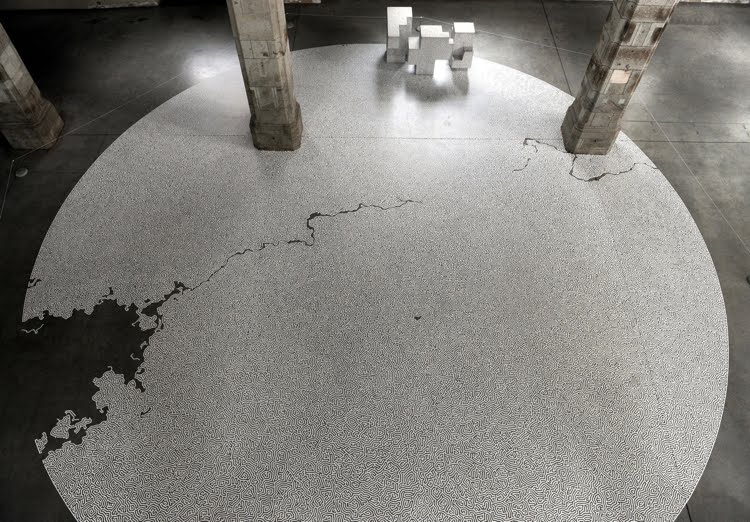
Motoi Yamamoto uses more than a tonne of salt to create exquisitely detailed mazes. These 'sculptures', akin to sand painting, creep through existing spaces, invading, flaunting the nature of salt itself. In a Co.Design article, it was reported that one of these pieces in Cologne were deconstructed by its viewers and they were allowed to redistribute the salt to where ever they wanted, be it sea or soil, to 'contribute to new life'. Interestingly, a comment points out that salting the soil was a cruel form of ancient warfare; salted soil allows nothing to grow as experienced by areas with soil salinisation. What is this bitter twist at the end of this elegance? Salt versus sugar? These works are not solely visual, but on a sensory level, the sheer presence of salt adds a gustatory influence - that salt can sting the tongue.

Vue

Lunch at Vue, top of Mercure Hotel, Customs Street East, Auckland. It had some wonderful service, although expected of a place like this, especially since there weren't that many patrons during high lunchtime. Nice light lunches without being skimpy - the food itself was quite regular (wish it had some more X-factor). A wonderful view if you sit in the right place (sea view is great minus the extreme winter sun. A good range of seating caters for all sorts of occasions. Also connected to a great lounge/bar area. Can't wait to try it for dinner!

Engorged

A while back there was an exhibition at the Auckland Art Gallery which was all about food. It seemed like a bit of a frivolous topic, but then who is to judge art for it's frivolities? Can it not be a powerful medium? Lee Price uses the most charming of desserts to highlight over-indulgence and the sheer gluttony of human existence, with a more minimalistic approach compared to Jacquey Fahey.

Culinary


Watching Masterchef is one of my favourite reality TV past times since it is the competitive cut throat of any on-screen competition without the bitchy over-drama that often plagues the genre. And it is creative cooking.

Fine cuisine no less, the painstaking kitchen of the likes of Euro come to keen New Zealand eyes. It leaves me, the foodie that I am, pondering what that tiny droplet which, reportedly, was a sugar shell encasing a drop of olive oil, would taste, feel and be like. Who ever thought that up as the ultimate garnish had something creative going on. And it's always the mysteries of the world which affords curiosity.

Recently I was invited to dinner at Soul, which is possibly the closest I will be to super fine dining in the nearish future. My four ravioli (I regret not ordering six!) sat at the bottom of an interesting visual delight of salad. Prying open the forest of roasted herbs, a bed of cress was revealed. Undoubtedly, the combination of flavours was superb. What got to me was how the dish was designed, so almost unsimple about the way it was formed and given as an experience. After having wrestled with the idea since Creative Collision's conception, I decided that the culinary should take a proud spot on this blog.

Notice the new category 'Culinary' appear on the menu at Creative Collision. Foodie adventures, travels and experiences - only the deliciously creative shall make it to this blog.