Creative Collision Blog

Creative Collision Blog Cross-disciplinary Creativity


Behind Creative Collision


Showing posts with label Social Media. Show all posts

NZFW6

Not as immersed in NZ Fashion Week as I was last year, but I'll be off to a few NZFW 2013 shows just to keep the creative mind sharp while writing a thesis.

Ticket to the show
The other night I got tickets to the Stolen Girlfriends Club show and as usual (rebelliously) they had an off-site show. It was quite different to shooting last year's show (or maybe it was because I was in the audience as opposed to the photographer's stand) but just as impressive. The style of the clothes were inspired by 'Dirty Magic' so think dark, grungy street style and some avant garde evening wear. It's great to see a mix of male and female clothing in a show, too.

A giant projection on the facade of the building.


Important

A message to the paparazzi by Benedict Cumberbatch, known to some of us as the 'new' Sherlock:

Some food for thought as to where our photography/journalism talent is going or not going.

Alignment

Loved this photo of Vulcan Lane. Reminded me that it's one of Auckland's pedestrian 'laneways'. Think Melbourne style. Will have to get it in the thesis somehow. Vulcan Lane was one of my favourite spots, now overtaken by other places in the city. The subtext which is "Yay! We actually have choices now!"


Thanks @antsgardiner for the inspiration.

Scale


An interesting article on Co.LABS highlights the significance of scale with platforms like Twitter. When you send one package of data off to another person, that seems like a pretty simple thing with the internet. But Twitter is a vastly upscaled version of that - 150 million active users (the most active ones probably fire off a tweet at every moment's whim). That's a lot of packages to send through.

When things fail, you end up with the 'fail whale' page and although the meme is cute, the situation of not being able to use the service definitely isn't.

Twitter is constantly upgrading its infrastructure to deal with this mass of tweets. You can imagine how many bits of data need to be sent if a big star with millions of followers drops a tweet, followed by a flurry of retweets, etc. There will always be a bottleneck and a bit of clever shifting allows the data base to cope.

In the same way, when cities become bigger (we talk of metropolises and megalopolis, with more to come, I'm sure), the infrastructure needs to change with it. How to transport, water and feed millions more people in a concentrated area is a big question with our current rate of growth. For instance, the plans for a future Auckland has sparked debate on many fronts - even a whole different scheme for our transport system created by transport enthusiasts on the Auckland Transport Blog. Careful thought has to go into infrastructure alongside any future growth.

We don't want our city becoming an urban fail whale.

Eco-mobility

What ifs: a future with eco-mobility.

Auckland, New Zealand, may be a small-scale city compared to others around the world but it has its share of mobility issues. It certainly isn't ‘eco-mobile’. Give us the slightest drizzle of rain and suddenly traffic jams up. Our public transport system? A prime target for casual hate sentiment. On a bad day it even has its own hashtag on Twitter.


Our lingering problem is that Auckland grew out generally unplanned. A few centres formed then the rest was haphazard 'fill the gaps' development. An extensive coast-to-coast tram network was removed in the modernist 1950s in favour of cars, cars and more cars. That unfortunate mentality remains today – it is our symbol of freedom, a part of the Kiwi dream.


But now in the 21st century, we have the knowledge and, hopefully, the drive to create more sustainable transport options for the future of our cities. In an attempt to experience the local day-to-day of Melbourne, Australia, I chose to travel everyday by train in from the suburbs. The transport card reminded me of similar systems I used around London and China – the hallmark of an integrated transport network. Of course, there are the things to be expected: an occasional late train, thinking "why did I ever resort to public transport?" But all in all, the robust infrastructure allows you to go anywhere around Melbourne without a car.


There is always a rivalry between New Zealand and our neighbour Australia. Auckland, like many cities around the world, is going through some growth pains. Transport infrastructure, such as the City Rail Link, aimed at a future Auckland is being introduced, sparking great debate. Although we may beat many Australian cities on the ubiquitous liveability scales, this won’t continue if Auckland grows at its current rate without further thought and action.
"We know there is still a lot of work to be done. Our transport infrastructure puts us behind other cities on the international indices, and handicaps our people and our economy."
- Mayor Len Brown, Mayor of Auckland 

It’s just so hard for people operating in a car-centric city like Auckland to even imagine what it would be like to be in an eco-mobile city. We don’t know what it is like to live in a cycling city such as Amsterdam or drive around in an eco-mobile vehicle.  We don't know how it feels to be in a city without a desperate need for cars and smelly diesel buses! Connecting with other cities with different technologies and new ideas on eco-mobility gives us more insight to improve our city's transport.


The Eco-mobility World Festival 2013 happening later in the year calls upon the ‘global village’ to explore these ideas. The Korean city of Suwon takes on a very practical challenge to prove the merits of eco-mobility. Using technologies and approaches from across the world, the Haenggung-dong neighbourhood is going without cars for an entire month during the festival. Is this an incredible feat? Or will be it effortless? We shall see! This is where some people will get to experience eco-mobility in the flesh. For the rest of us who aren’t at the festival, this knowledge will be shared over oceans to start changing our thinking around daily transport; a different philosophy in getting from A to B. 

Personally, I can’t wait to see what comes out of it!

Post-it2

A tweet from New York Times reporter Hiroko Tabuchi caught my eye. It was about a creative process that her husband was going through and tweeting about. Makes me want to have a post-it wall thinking process, too!
See other posts about creative uses of post-its: one of a wall for Mother's Day and another left by a creative barista.

Vibrant

Tiffany Leong architecture thesis project Chinatown
Tiffany Leong's thesis project worked with the Vancouver Chinatown.

Today I happened across (yet another) thesis project about the Chinatown. I've found each thesis I've seen has a different take on the subject and this one is no different. This time it was about Vancouver's Winnipeg Chinatown, one of the largest in North America.
The project came from a 5th generation Chinese Canadian, honouring the memory of the iconic Shanghai Restaurant that her great-grandfather had championed. None of the younger generation wanted to take on the restaurant - there are many cases that I know of here in New Zealand.

Tiffany Leong creates a small scale intervention on the site to the former restaurant. It rises two stories, with a roof inspired by Chinese paper art. It is at the street level that this scheme shows the momentum of the Chinatown condition - a transparency and porosity with the help of pocket doors, louvres and folding partitions. What this does is create human-scale connections that blur the line between public and private. It also draws inspiration from the hidden passages and spaces typical of Chinatowns around the world.

It can be said that Chinatowns were created by the circumstances of the time of formation - Chinatowns are now used very differently from the past. They are less ethnic enclaves (a response to racial discrimination and abuse) and more 'vibrant' communities with a mix of interesting eateries. It can be argued that this typology is not relevant in today's day and age, too. Without a formal Chinatown, Auckland now has pockets of predominantly Chinese areas ('predominantly' because there are many other cultures alongside - Thai, Japanese, Indian, Middle Eastern) and any intervention would have to be inclusive. This may or may not have a role for Chinatown spatial typologies which is why I am not looking only at 'Chinatowns' and their countless examples, but further back drawing inspiration upon the roots of Chinese culture.

Connection

With the gap between the Capitol Cinema and the buildings on the north side, there is an opportunity to connect the mainstreet (Dominion Road) with the back street (the service lane/multiuse space between Balmoral shops and behind the Warehouse). Furthermore, there is a potential connection from the backstreet across to the Warehouse carpark, perhaps activating that space.

A further cross connection such as this one increases flow through layers of Balmoral, instead of depending on vehicle trodden routes which move around blocks. Good examples of these small but effective connections are Fearon Hay's Imperial Lane and the path inside of RTA Studio's Ironbank Building on Karangahape Road.

Fearon Hay's Imperial Lane between Queen Street Fort Lane Auckland
Within Imperial Lane, a slight bend in the axis from Fort Lane (front) to Queen Street  (lighted path in the back right).  A slight slope up to the central area creates a sense of elevation and arrival as a threshold to Fort Lane. The entrance at Queen Street, on the other hand, is camouflaged among the other street frontages.
In Imperial Lane, the space between the historic Queen Street buildings are converted into a commercial/eatery/office spaces with contemporary materials working in the same language as the industrial past of the original shell. Connecting Queen Street (importantly the downtown area) and Imperial Lane which, before the streetscape renovation, was a dumpy back alley with unpleasant smells (still has some today I suppose), Imperial Lane's connection breaks up the large block into more pedestrian friendly paths to Fort Lane, Customs Street and Fort Street - a new network beneficial for the area that breaks away from the straight street edge typology typical of Queen Street and Balmoral Shops.
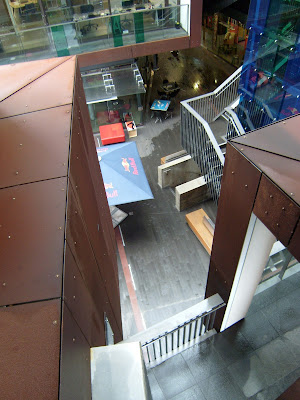
The connection within RTA Studio Ironbank building K Road Auckland
At the Ironbank, the path access from K Road to Cross Street bends around approviding approaches to the internal courtyard (activated by beanbags and the umbrellas) creating a multi-axial and inhabitable semi-public space.
The Iron Bank on the other hand does not bore through an existing fabric. Within the building complex itself, a pedestrian pathway was formed, connecting K Road with Cross Street around the back. Interestingly the path is not a straight one - this also decreases the likelihood of the lane becoming a wind tunnel (although first hand experience shows that there is a bit of a problem with this).

A common trait between these examples is that there is a bend in the connecting street and through route is activated with different uses - beanbags, tables and chairs, game machines. The space between Dominion Road and the Warehouse carpark has a bend also, which provides micro-climate protection (i.e. against wind tunnels) and possibilities for an interesting activated space.

I had a bit of a conversation on Twitter about these urban connections with @citysituated, an urban planner, just within the fleeting dialogue we had recalled a bunch of great examples where small scale connectivity in the city helps create vibrant pedestrian networks. Airbridges at PWC, Takutai Square, Cross Street, connecting arcades in Queens Arcade, Midcity... all to varying degrees of success.

Model1

Balmoral shops heritage model architecture
Site model of a part of Balmoral, focusing on the back area behind Capitol Cinema and Warehouse building. Warehouse and rear buildings not in yet. 1 : 200 scale. 
Even with this partially completed site model, the typology of buildings next to the intersection at Balmoral can be seen. The straight edge frontage on Dominion Road, the joined shops all stretching back to various degrees. The largest building at Balmoral shops is the Capitol Cinema, the large one in the centre. Off to the extreme left, the row of shops end to the landscaped corner of the large Balmoral-Dominion Road intersection opposite Potter's Park.

Back view of Capitol Cinema Ngaire Chambers Warehouse Balmoral
Around the back, the staggered formation of buildings and for some of them, their patched together nature, can be felt. Admittedly, there are yet more little shacks attached to the ends of some of the second storey levels and in real life, cars fill up most of the indented spaces.
Street facade model of Balmoral shops
To the right hand side of the Capitol Cinema, a tiny shop was plugged in between  the heritage cinema and the Ngaire Chambers (modeled with its facade siloheutte). To the left of the cinema, there is a space like an alleyway closed off from the street with a poster ridden gate. I've left it open, perhaps a way for me to establish a connection between these interesting back spaces and the mainstreet. It also has a vertical nature.
The Unitary Plan lists Balmoral as one of the 'historic character – business’ zones. In light of future intensification, the local centre zoning also allows for up to four storeys (currently most are two storey, Capitol may be considered three) with residential units allowed on the top stories (which is what Balmoral has already). Great opportunities with the air space around these buildings but need to keep thinking about the 'historic character' of the architecture that makes Balmoral so urban and distinctive.

In terms of memory (one of the main themes of my thesis), a friend commented in studio that he knows that space between Capitol and Warehouse very well... apparently he goes there to get cardboard boxes! For others, this space is their home street, you can see by the amount of colourful laundry hanging on stair railings.

I'll be posting more about this model as it evolves - eventually I'll be adding some designed elements to it to explore what could happen in this space. I'm also looking forward to the Taniwha and Chinese Festival next Saturday (27th April) which will see a pōwhiri between Maori and Chinese. Thanks @NZBC88 for the heads up.

Trust


With the advent of 'internet piracy', the music industry is changing and there are some who are embracing new ways to make a living with making music (as well as those who resist of course). A great example is Amanda Palmer, whose style is a mix between punk and cabaret. Personally not my flavour of music but wow, the way she goes about sharing her music is powerful stuff.

Amanda Palmer trust - this is the future of music

Her main game is trust: trusting fans, couch surfing & crowd surfing (which she talks a bit about in her TED talk - showed above, well worth viewing) and allowing those fleeting moments of interaction with people to form that trust. An extremist devotee of trust (compared to most of us anyway), it has served her well. She keeps coming back to one of her jobs standing on the street as an 8-foot bride, kind of like busking for money. Short moments of bonding, the experience of being acknowledged (good and bad), and an apparently steady income taught her this new path of music making.

If she comes to Auckland for a free gig or something, would love to see her work her magic. She also has a very well populated Twitter account which has helped with real time crowd/fan engagement.

Humans

Over the last while a controversy over street photos taken by Humans of New York came to light where the renown fashion label DKNY used the a bunch of photos in their Thailand shop front without credit or payment for the right to use the photos. You can read a good article about it on the Wall Street Journal.


Retaliating with a Facebook post demanding DKNY to own up to its mistake and donate the proceeds to a local Brooklyn charity, DKNY did eventually own up, saying it was a mistake and that they will go ahead with paying the charity. I thought it was all done and dusted - a pretty good outcome to a pretty bad situation on all sides. A global label like DKNY having a lapse in communication with an Asian branch? Understandable.

But it didn't stop. A stinging vindictiveness from the supporters of Humans of New York and from those standing up for intellectual property rights for creative products (which in itself is a terribly controversial issue with fuzzy boundaries and awkward skirmishes in price battles such as the one in this example). Humans of New York happened to take the initiative this time and got a compromise but still DKNY is still getting trashed post-apology. Perhaps it's the easiness of just pressing a 'like' button, the epitome of a 21st century cliché, or the convenience of reading half a sentence on a very long (partially hidden) post and sharing a scathing comment.

In the creative industries, it's not always clear cut but more importantly, the field is malleable and open to new collaborations. There are many ways to go about crediting/PR and I think this example is a particularly creative example of standing up for one's creative property rights. But let's remember that we are also human and prone to mistakes.

To see the raging comments about the issue (which toss between different views), see the Facebook post that started it all.

Nostalgia

China Pavilion people dwarfed nostalgia big Shanghai Expo

The Round Robin Photo Challenges is a blog I bumped into randomly the other day. At a predetermined challenge date, people post up a photo according to a theme and link back to it in the comments, allowing others to appreciate a collection of work that is almost curated around the theme.

This time the theme is "Long Ago, Far Away" and definitely a good excuse to trawl through old photos that would otherwise just rot away (OK, not really) on the hard drive. This photo is from the Shanghai World Exposition of 2010, the China Pavilion which was, of course, the grandest, largest and most boastful. A great moment on its doorstep was seeing how the building literally dwarfed the people lining the bottom of the photo. Perhaps it's not all that long ago that this was taken, but it sure feels like a long time and so far away from life here in NZ.

Fall

Creative journalism.

All too often we hear about the slow but sure fall of the printed news media in the 21st century. While this is debatable as a phenomenon, digital media is readily growing into 'traditional' media. Traditional media has reinvented itself so much that the two are inseparable and the gnarled boughs of printed media is worked in with the temporality of social media, the internet and multimedia.


Today I saw a superbly made multimedia project by +The New York Times  reporting a story that really went to the heart of the story. Snow Fall: The Avalanche at Tunnel Creek by John Branch reads like a novel at times in its composure and thorough research into its subject. Using current web design to integrate the multimedia components really helped with understanding the story which is epic in scale and tragedy. Fly-throughs of the mountain, simulations, videos and an assortment of bite sized supplements to the story really lend support to this feature.

The reporting for this article on the Feb. 19 avalanche at Tunnel Creek was done over six months. It involved interviews with every survivor, the families of the deceased, first responders at Tunnel Creek, officials at Stevens Pass and snow-science experts. It also included the examination of reports by the police, the medical examiner and the Stevens Pass Ski Patrol, as well as 40 calls to 911 made in the aftermath of the avalanche. The Swiss Federal Institute for Snow and Avalanche Research provided a computer-generated simulation of the avalanche, based on data accumulated from the Stevens Pass accident report and witness accounts. Additional sources are: LIDAR data from King County GIS Center; Iowa Environmental Mesonet, Iowa State University; Mark Moore, U.S. Forest Service; National Avalanche Center.
As well as being a rare effort to report content that the likes of social media couldn't access, this project has an unusually long timeline. Keeping in mind that traditional media hardly ever breaks the news as news any more (that is if you utilise the hyperconnectivity of internet/social media), this is really breaking the box a bit - does traditional media, and its newer form on the digital platforms, allow this slow-cooked information to become a key part of its arsenal in the digital, fast-paced world?

A friend has an interesting observation. After reading the first line he immediately had the impression that it was a piece of fiction writing. Although the drama and writing is captivating, you wonder whether or not it is dramatised beyond belief. If only they put an acknowledgement of the real event and its seriousness before the drama kicked it. As you read on, each of the people's photos show up on the side, a nice touch that links it back to personal reality.

It could be said that only big media reputations could pull such a thing off. The sheer force of the name and the resources in the background offer a unique position to explore issues that deserve more than the double spread feature. And they look like they're milking this experimental format - an e-book is also available for purchase. It seems this media giant is treading a thin line, but which line is it?

Station

A delightful piece of proactive space-making took the opportunity of a empty bus stop in Brooklyn, Wellington. During refurbishment the council had removed the seating in the rather homey brick station. They didn't seem to return.

An anonymous local stepped up to the task and made it into a pleasant waiting space with a touch of the domestic.


Thanks AMidnightVoyage for the heads up on Twitter. For more pics and a bit of commentary, visit the original posting.

Record


A tweet from Mt Eden Dubstep recently caught my attention:
@MtEdenOfficial: We never had anything except the bare minimum equipment since we started... finally getting up to industry standards feels good
Despite not having a huge amount of equipment for a genre of music that requires quite a bit of specialised equipment to make, Mt Eden has done so well in the local and now global dubstep scene. As they move into their first studio in NYC (from their humble 'bedroom studio'), we'll see how their style of music develops.

Many big name bands started out of garage studios with limited equipment but it should never be the limitation on creativity. Big bands such as Linkin Park started with grungy garage demo tapes before eventually expanding the empire. Now they have a fantastic studio which I believe has also changed their style of music as they experiment to their heart's content. For one, audio editing has removed the grit of a lot of today's music.

How much does a studio environment affect the creative process and outputs? Is it fair for a creative practitioner to blame a lack of tools and resources? However we go about it, it's the creative thinking and approach to one's art that really counts.

Us

After a gruelling semester of architecture studies, I'm back on the blog (and Twitter) after my usual crit hiatus. Something that's been lingering on my bookmarks bar for a while is the Us cover of Rihanna's hit 'Where have you been'.


Very rarely do you find a cover as innovative as this. The husband wife duo, Carissa Rae and Michael Alvarado, created a fusion of genres for this very familiar pop song, with hints of classical influence, rock, jazz and a unique interpretation. Do enjoy and I'm looking forward to blogging over the summer, especially with an upcoming trip to China's villages!

Check out more from Us on their website HaveYouHeardOfUs.com. If you like their work, make sure you support them by purchasing their song or album.

Score

Deadline looms and projects are firing up (not to mention a backlash from NZFW) so there hasn't been much time to blog lately. Here is a tweet I saw of Imogen Heap, showing the beginnings of a score she is working on for the documentary film The Happiest Place. I love how it is more of a doodle of ideas and impressions rather than formalistic notation at this stage.


@imogenheap: Beginnings of score writing process for @HappiestFilm :) http://instagr.am/p/PweI8VFEL0/ 


Shadows2


What better way is there to extrapolate a real life scenario than within a modern gaming environment. Despite the drama spinning of role-playing games, they can act like a simulation of the future human condition. What's more, these days we can already see the emphasis on digital data taking a larger role in society. Presidential campaigns in America have become increasingly data-saavy, with Obama's use of data analysis and Romney's low profile data-mining expedition. Does this mean the vote can be swayed just by aligning with the majority mindset? Is this manipulation or falsity?

NASA satellite composite image earth at night
Eric Fischer’s map of Twitter interaction
See how interconnected and similar the physical world is with the digital world - Top: NASA’s satellite composite image of the earth at night.  Bottom: Eric Fischer’s map of Twitter interaction.
Watch Dogs is a game that follows characters that can exploit the data rich systems that are intertwined with our cities. I once wrote a paper about the urban design theory on the use of Twitter in cities and despite being a study of an emerging and fresh communication network, it seems primitive compared to the world described in Watch Dogs. It might not necessarily be a very different world physically but the dependence on a data network is both a great nod to technological efficiency and a huge amount of real time data waiting to be used for malevolence.

Watch Dogs 2012 game digital shadow

The 'shadow' which this game describes is not a physical shadow. The digital shadow that we all leave behind by writing blogs like this, using social media, filling in forms and even doing a simple Google search can drive anyone to manic paranoia if we think too hard about it. Other than being an exciting game with some awesome gimmicks (like hacking the electric grid from a cellphone), the setting is a very likely future condition that gives us all something to think about.

See the E3 Game Demo showing how personal data, the electricity grid and phone bugging is at one's fingertips. "I know how you think"...

Reject

A timely FB post from Cameron Sinclair says that it would have been Andy Warhol's 84th birthday. I, for one, can't imagine the King of Pop Art being that old. There's something explosive about the short life of a lively artist.

P.S. The drawing may be picked up from the museum at your convenience.

When Warhol was 28 years old, he offered a drawing to MoMA, only for it to be rejected outright in a standard letter. See his work now, possibly in the annals of the same MoMA. A stinging reminder not to give up on our creative aspirations.

DMONIC


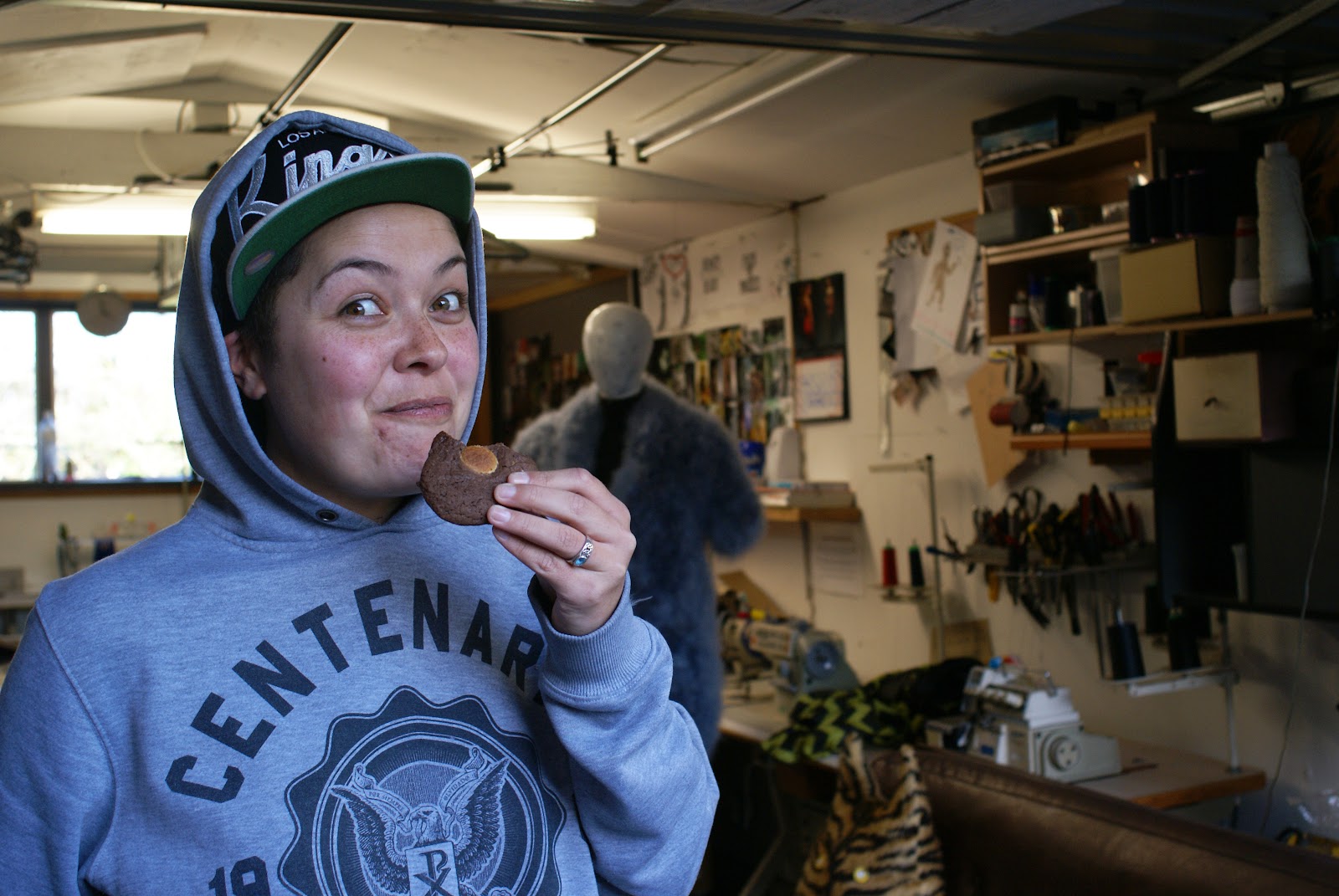
DMONIC INTENT is an up and coming fashion label, thriving on the enthusiasm and passion of the Woolridge sisters. I paid them a visit at their workspace - a productive conversion of the good ol' garage in Glen Innes.

Max, one of the sisters that make up DMONIC INTENT. After having tried many different creative disciplines, she had a eureka moment when she found her sweet spot in fashion.

Creative workspaces have always been a fascination of mine. My own has always been a bit of a dark cave filled with gigantic sheets of paper, chemicals, modelling materials and a shelf crammed full of books. It reflects my creative practice and this can be said for pretty much any creative person.

In this way, the workspace of DMONIC INTENT is full of an interesting mix of tools and inspiration. A Maori whakairo carving stands in the corner, a sentinel of the space. A little jewellery making desk is full of promise but at the moment is intruded with boxes of textiles. On the cutting table, a huge scroll of brown pattern making card unravels potential. Beyond the garage door, their creative community, including their photographer, sits around a table for a cuppa and a chat.


DMONIC INTENT makes more than just clothes. Their stunning jewellery collections are a force to be reckoned with. There is also a graphic design feel mixed into the conceptual drawings tacked on the walls, probably owing to Max's background in graphic design. I love their fun, easy going attitude to their art and how welcoming they were to invite my friend and I to visit.


DMONIC INTENT are due to be featured in the 2012 NZ Fashion Week in the Miromoda and New Generation Shows. Some of their jewellery will also be featured in other shows so look out for them! Check out their work on the DMONIC INTENT Facebook page or follow them on Twitter.